
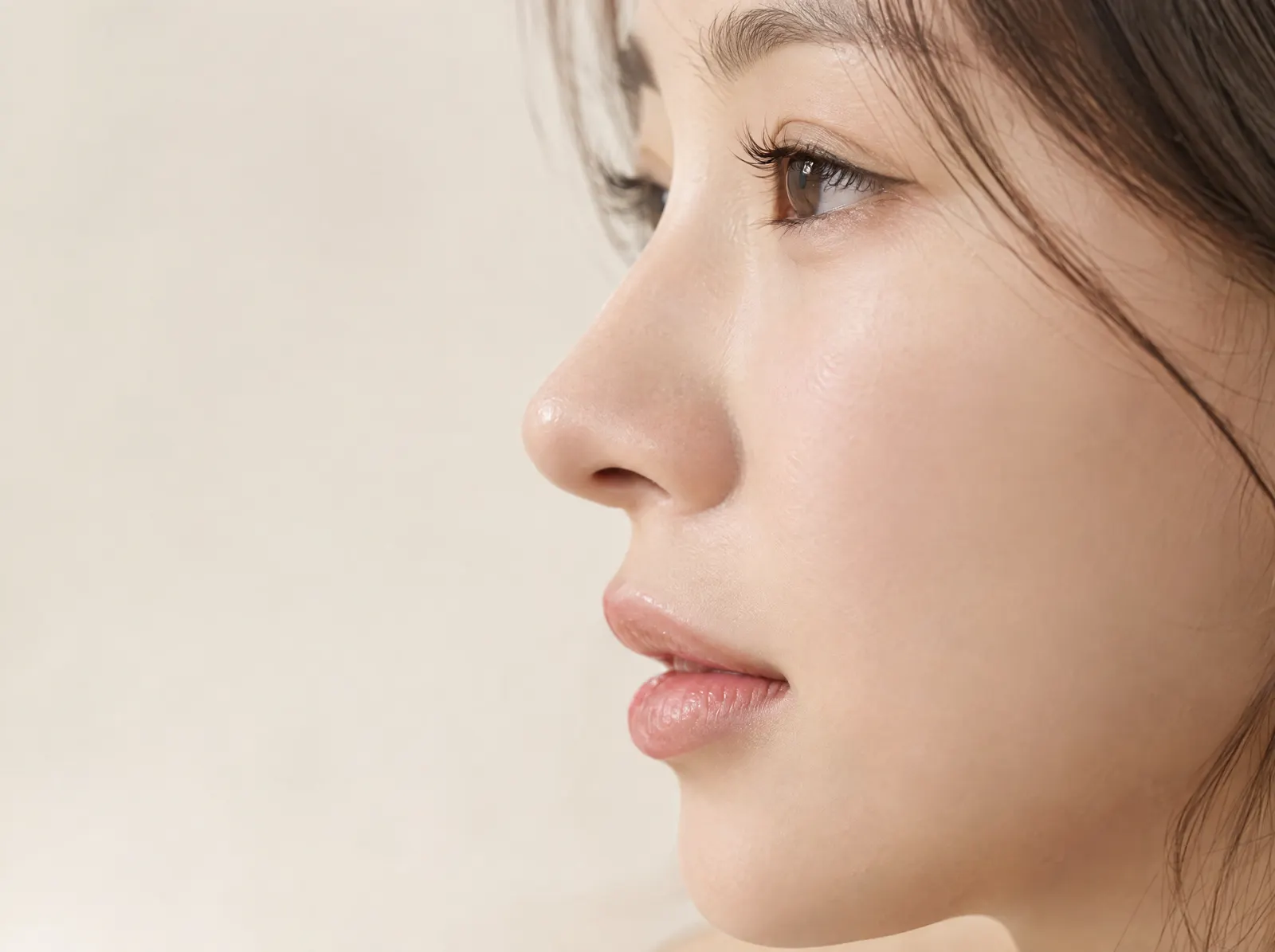
We examine the position and size of the columella
and plan a columella shape that suits the nasal tip.
SEHYUN PLASTIC SURGERY
Columella Correction
COLUMELLA CORRECTION
SEHYUN PLASTIC SURGERY
Rhinoplasty · Columella Correction
SEHYUN AESTHETIC CLINIC
What Is Columella Correction?
The columella is the column of tissue that separates the two nostrils. Columella correction is surgery that reshapes this column when it hangs down, looks retracted, or has become thick.
CHECK POINTS
Retracted and Hanging Columella
A columella that shows too much or looks hidden is related to the shape of the tip cartilage, the lower end of the septum and drooping nostril wings. Seen from the side, if the columella is close to, or further inside, the line connecting the upper and lower ends of the nostril, it is considered retracted. Conversely, if it comes down 2 mm or more below that line, it can be considered hanging.
A hanging columella occurs when the tip droops downward, as in a drooping tip, when the columellar cartilage is large, or when the lower end of the septal cartilage extends far downward.
Columellar retraction occurs when the columellar cartilage is small and the lower end of the septal cartilage is short.
When the nostril wings droop downward, the columella looks even more retracted. Columellar retraction and drooping nostril wings often occur together. They need to be told apart in diagnosis and surgery.
CASE
Rhinoplasty before-and-after photos are available after you log in as a member.
Each individual's outcome after surgery is different.

CASE 1
Retracted Columella

CASE 2
Hanging Columella
TYPES
Correction Methods by Columella Shape
The correction method depends on whether the columella hangs down, is retracted, or has become thick from previous surgery.
Reducing a Hanging (Drooping) Columella
When the columella hangs down, it stands out in profile. If it hangs significantly, part of the cartilage is trimmed to shorten the columella, and in a long nose where the tip cartilage droops downward, that tip cartilage is repositioned so that the direction of the tip is corrected as well.
Revision to Correct a Thickened Columella
If the columella has become thick from cartilage added on the columellar side during tip surgery, we first look at the condition of the remaining cartilage and the cartilage used before. If it is judged suitable for reuse, that cartilage is trimmed and used, and the cartilage supporting the tip is kept to a minimum in the plan.
Lowering a Retracted Columella
If the columella does not come down enough, the tip looks upturned and the nostrils are very visible from the front. In this case, rather than simply pulling the columella down, we look at the length of the nose and the structure of the tip cartilage together and adjust the direction of the tip downward with cartilage repositioning and the split tip support technique, which supports the tip point (nasal tip), adding cartilage to make up for the length of the nose if needed.
DR. YOO TECHNIC
Features of Dr. Yoo Hyun-seok’s Split Tip Support Technique
Dr. Yoo Hyun-seok’s technique supports the area directly beneath the tip point, where support is needed most,
while supporting the tip point and the columella separately.
Preserving the Membranous Septum
The membrane between the soft columella and the septal cartilage (the membranous septum) is preserved so that the columella can move to some extent.
Support That Is Not Fixed as a Single Block
The columellar part of the tip cartilage (alar cartilage) and the septal cartilage are not fixed together as a single block. A sturdy support structure can be made even with relatively small pieces of cartilage.
This method does not fully guarantee movement; movement within a limited range is possible, but the tip does not move freely.
Columella Thickness and Skin Border
Sehyun's split tip support technique aims to keep the columella from becoming thick, to preserve the original border between the columella and the skin inside the nostrils, and to keep the area beneath the tip from dropping or the tip from looking long after surgery.
SIDE EFFECTS
Possible Side Effects and Scarring After Surgery
Some reactions pass during recovery, while some changes in shape appear only after several months.
01
Swelling, Bruising and Firmness
In the early period after surgery, the tip and the area around the columella may swell and bruise, and the tip often feels hard for a while before improving as the tissue softens.
02
Inflammation and Infection
If wound healing is slow, inflammation or infection can develop at the surgical site. If the columella and tip become increasingly red, with growing warmth and pain, it may be inflammation, so contact the clinic right away.
03
When the Shape Changes Differently from What You Expected
If the tip lacks support, it can droop again over time, or, conversely, contracture can pull the tip upward and leave the nostrils asymmetrical. As the soft tissue weakens with age, the tip may also gradually come down.
04
Scarring
When only the cartilage of a hanging columella is trimmed, the incision is made inside the nose, so the scar stays hidden within the nostril. When the surgery uses an open approach with an incision across the columella, as in a revision that has to rebuild a collapsed tip support structure, a short incision scar forms on the skin of the columella. While the incision site is still red, protect it from UV rays.
RECOVERY
Until the Swelling Goes Down and the Columella Shape Settles
Because the columella is connected to the tip, the course of recovery depends on how much tip surgery was done at the same time, and the recovery period is about 2 weeks.
The tip has thick, firm skin, so residual swelling can linger for a long time; the final shape of the columella and tip is assessed after allowing about 6 months to 1 year. How quickly residual swelling goes down varies from person to person.
CARE
Precautions After Columella Correction
Because the columella sits between the nostrils, it is easily pressed without your noticing when you wash your face or sleep.
- 01For the first week, keep your hands off your nose, avoid sleeping face down or with your face buried in a pillow, and sleep with your upper body slightly raised.
- 02From right after surgery through the third day, use cold compresses to ease swelling and pain, but cool the areas around the eyes and the cheeks rather than placing them directly on the columella or tip.
- 03Once the bruises start turning yellow, switch to warm compresses close to body temperature.
- 04Wash your face with lukewarm water and avoid rubbing hard around the nostrils and the columella.
- 05Avoid alcohol and smoking for at least a month. Alcohol can increase swelling, and smoking can impair blood circulation and slow wound healing.
- 06Hold off on exercise that makes you sweat heavily, and on saunas, for about a month, and keep active with light walks instead.
CONSULTATION
What to Determine First in a Columella Consultation
When the nostrils are very visible from the front, what needs to be corrected depends on whether the columella has not come down enough or the nostril wings are raised. At the consultation, we identify this cause and also decide where to take cartilage for supporting the tip and how much to use.
Chief Surgeon Dr. Yoo Hyun-seok, a board-certified plastic surgeon, personally decides how far to correct after looking at the length and width of the columella and the point where the nostril wings are raised the most. If it is a revision, please bring photos from before your first surgery. They let us compare how much of the current columella shape was changed by the previous surgery.
Q&A
Q.Can the columella be corrected on its own?
It is an option when the trouble stays confined to tissue in one area. If it is connected to tip rotation, the septum or the nostril wings, these may need to be adjusted together.
Q.If the columella is crooked, does that mean the septum is crooked too?
The two can occur together, but they are not always the same problem. Asymmetry of the tip cartilage, scarring and existing grafts can also be causes.
Q.Will my tip become hard after columella correction?
How it feels depends on the size, position and fixation of the graft and on scarring. In particular, when a retracted columella is lengthened and the tissue is less flexible, movement may be limited and it may feel hard.
Q.After tip surgery, my columella seems thicker and my tip seems to have dropped. Why does this happen?
If a large cartilage strut is placed in the columella to support the tip, the columella can thicken or drop over time, making the tip feel slightly long and blunt. The area running from the columella to the tip may also feel stiff.
Q.I've heard that after tip surgery you can't push your nose up into a "pig nose." Is that true?
That can happen. If the columella is fixed broadly to support the tip, the tip may not move as much when pushed up. How much the tip can move after surgery varies from person to person.
Q.How is the cost of columella correction determined?
The cost depends on whether only the cartilage of the hanging columella needs trimming or the tip cartilage must also be repositioned to change its direction. The exact amount is given in a cost consultation after diagnosis.
SEHYUN CONSULTING
Counsel
Please choose the area you would like to discuss during your consultation
ONLINE COUNSEL
Please use Online Consultation to tell us which area you would like to discuss and provide your contact details, or call us at 02-540-4077.
SEHYUN CS CENTER
02-540-4077
Whenever you call, we will be glad to help you.
Clinic Hours
Weekdays
AM 10 : 00 ~ PM 06 : 00
Saturday
AM 10 : 00 ~ PM 04 : 00
Closed every Thursday and on Sundays and public holidays.
Go to Online Consultation
Directions
4F Medical Bank Bldg., 12 Apgujeong-ro 36-gil, Gangnam-gu, Seoul
5-minute walk from Apgujeong Station Exit 2 (Line 3)
View Detailed Map
Sehyun
Aesthetic
Clinic
SEHYUN PLASTIC SURGERY

Sehyun Plastic Surgery
4F Medical Bank Bldg., 12 Apgujeong-ro 36-gil, Gangnam-gu, Seoul (620-1 Sinsa-dong), Apgujeong Station Exit 2
Representative: Yoo Hyun-seok Business Registration No.: 211-09-44896
Main Phone: 02-540-4077
COPYRIGHT (C) 2026 SEHYUN PLASTIC SURGERY.
ALL RIGHTS RESERVED.


Revision Rhinoplasty
Rhinoplasty
Eye Surgery
Anti-aging & Lifting
Before & After
About Us
Consultation & Booking
CLOSE


SEHYUN PLASTIC SURGERY
Members
Log In
Please log in with your Sehyun Plastic Surgery website member ID.
Don't show again today