
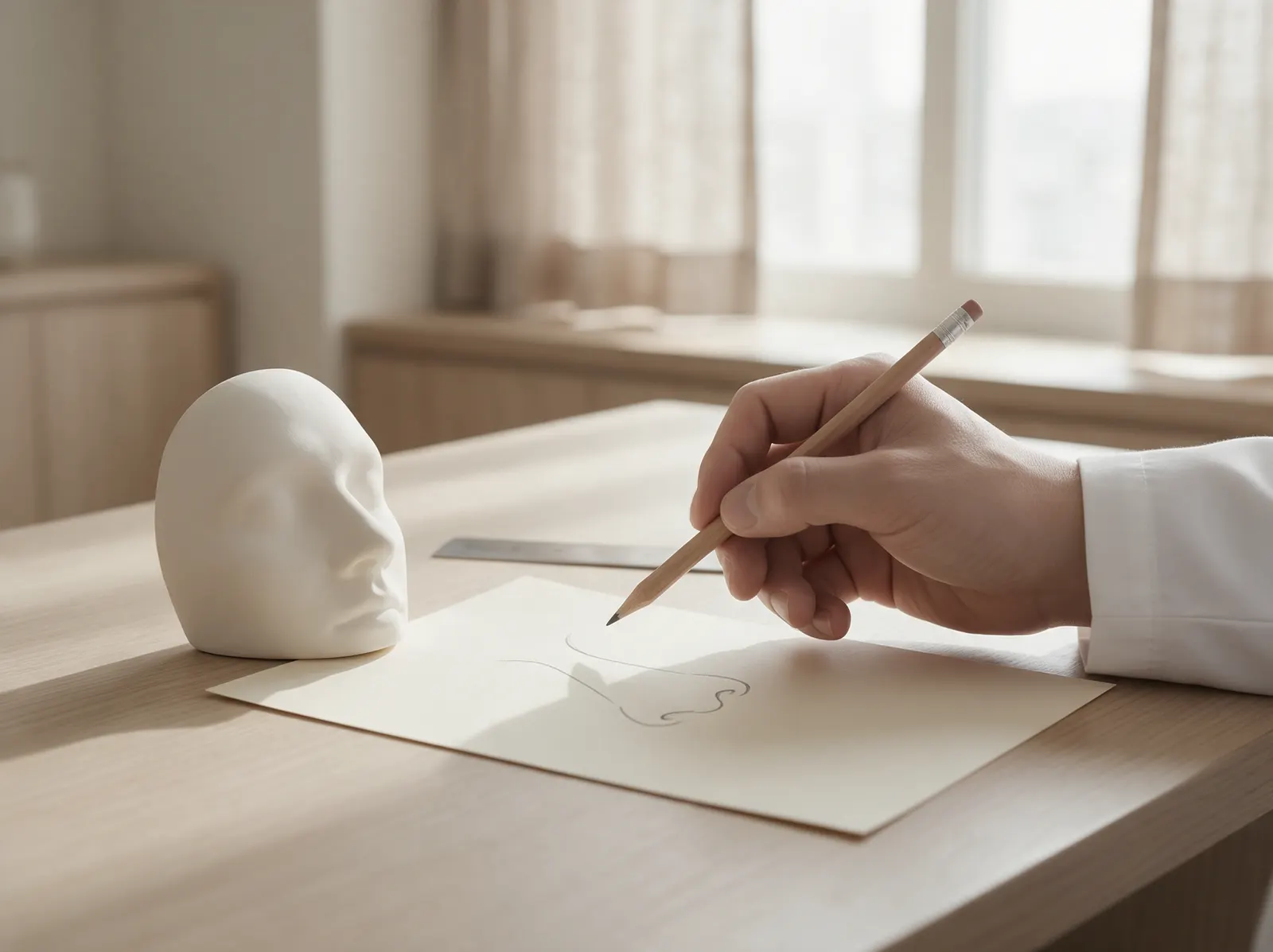
We first check whether the nasal bone or the septal cartilage is bent
and plan the correction based on the cause.
SEHYUN PLASTIC SURGERY
Crooked Nose Correction
DEVIATED NOSE
SEHYUN PLASTIC SURGERY
Rhinoplasty · Crooked Nose
SEHYUN AESTHETIC CLINIC
What is crooked nose correction?
A crooked nose is, as the name suggests, a nasal bridge that bends to one side, and crooked nose correction is surgery to straighten the bridge. The main causes are a bend in the nasal bone itself and a bend in the septal cartilage, which stands like a wall between the two nostrils (deviated septum).
If you have nasal obstruction or rhinitis, a deviated septum is often present as well, and in that case the breathing function is treated at the same time.
SEHYUN AESTHETIC CLINIC
Types of Crooked Nose
Normal nose
The nasal bone and tip form a straight line.
C-shaped crooked nose
This is a nose bent in a C-shaped curve from the bridge to the tip.
S-shaped crooked nose
This is a nose bent in an S shape from the upper bridge down to the tip, and it calls for the most challenging type of correction.
CHECK POINTS
What to Check in a Crooked Nose
- 01Where the nose starts to bend when seen from the front
- 02Which areas move away from the midline, using the line through the area between the brows, the tip, the philtrum and the chin as the axis
- 03Where the deviation begins
- 04Which way the tip is shifted from the central axis
- 05Whether there is asymmetry of the tip and nostrils or deviation of the columella
- 06What form the septal deviation takes
- 07Whether there is nasal obstruction and, if so, which side is worse
- 08Whether there has been past trauma, a fracture or septal surgery
PROCEDURE
Surgical Methods
The primary goal of surgery is to make the bridge look relatively straight from the front. At the same time, functional aspects (nasal obstruction, the nasal valve) are corrected. If the deviation starts from the upper part of the bridge, osteotomy is needed.
A deviated tip requires correction of the bend in the lower part of the septal cartilage.
For a low, crooked nose, silicone may be used on the bridge, and osteotomy then needs to be performed with great care.
A severely crooked nose requires rib cartilage.
METHODS
Correction Methods by Cause and Degree of Deviation
As shown below, the method of crooked nose surgery differs depending on whether the bend is in the nasal bone or the septal cartilage, or whether a previously placed implant has become crooked.
Method 1
When the bend is mild
Protruding areas are filed down or trimmed, and depressed areas are filled with harvested cartilage or dermis to correct the irregularities.
Method 2
When the bridge implant is crooked (revision)
This is when a previously placed implant was not secured and moved, or was placed off to one side from the start, so the bridge looks crooked. In this case, the implant is repositioned or replaced.
Covering a crooked bridge with an implant may seem simple, but if the cause of the deviation is left as it is, the implant can also be affected and shift, which may lead to another surgery.
Method 3
When the nasal bone is bent
When the nasal bone is bent, osteotomy is used to restore left-right symmetry.
At the same time, we check the alar cartilage, upper lateral cartilage and septal cartilage that make up the nose for any abnormalities, and correct them together if there is a problem.
Method 4
When the septal cartilage is bent and the upper lateral cartilages are asymmetrical
When the upper part of the septal cartilage is bent and the upper lateral cartilages on the two sides also differ in shape, the upper lateral cartilages are separated from the upper septum and repositioned to line up with the center.
Method 5
When the septal cartilage is severely bent
The bent portion of the cartilage is removed, and the septum is straightened.
The removed cartilage is then used as a batten graft to correct the deviation.
LIMITS
Limitations and Precautions
Because of asymmetry in the facial midline itself, the elasticity of cartilage, and differences in scarring and healing, a perfectly straight line or complete left-right symmetry is difficult to set as a goal. Cosmetic correction alone cannot be said to improve nasal obstruction, and conversely, functional surgery does not mean the outer appearance will take the shape you want.
CASE
Rhinoplasty before-and-after photos are available after you log in as a member.
How surgery turns out differs from one individual to another.
Crooked nose surgery reviews can be found and read in the Rhinoplasty Real Surgery Reviews list.

CASE 1
Corrected Mainly with Septal Correction

CASE 2
Corrected with Osteotomy
RECOVERY
Recovery and Precautions
After the septum is straightened, avoid blowing your nose hard or rubbing it for at least 1–2 months. The recovery period is about 2 weeks, and the speed of recovery varies from person to person.
Keeping your head elevated after surgery reduces swelling and bruising, so for the first few days, lie with your upper body slightly raised. While the nasal bones moved by osteotomy and the rebuilt septal cartilage heal in their new positions, no outside force should be put on the nose, so do not rest glasses on the bridge for at least the first month; how long to wait after that depends on the extent of the osteotomy and your recovery.
Even when bruising and swelling have cleared on the outside, the bone and cartilage inside may still be settling. The result of surgery is therefore judged by the shape once the bone and cartilage have settled.
SIDE EFFECTS
Side Effects and Scarring That Can Occur After Correcting the Septum and Irregularities
When the septum is addressed or depressed areas are filled with cartilage or dermis while correcting a crooked nose, the following side effects can occur.
01
Bleeding and Septal Hematoma
There may be heavy bleeding after surgery, or blood may collect between the layers of septal mucosa and form a hematoma. A hematoma has to be drained, so if a nosebleed does not stop or the inside of your nose feels completely blocked and painful, get checked at the clinic right away.
02
Infection and Adhesions Inside the Nose
If the inside of the nose becomes dry, discharge increases, or blockage or crusting continues for a long time, it may be infection or delayed wound healing, so get checked. Adhesions, in which the mucosa of the septum and of the side wall of the nasal cavity stick together, can also form.
03
Septal Perforation and Reduced Sense of Smell
A septal perforation (a hole in the septum) or a reduced sense of smell may occur. If a reduced sense of smell persists, you should be examined.
04
Reduced Sensation
The upper lip or front teeth may feel numb.
05
Sunken Bridge and Drooping Tip
If the repositioned septal cartilage is not secured well enough, the shape may change, with the middle of the bridge sinking or the tip support weakening.
06
Scarring
Small scars form where cartilage or dermis was taken to fill depressed areas. Septal correction is done through an incision in the mucosa inside the nostril, so the incision line is inside the nose.
TIMING
When to Correct a Crooked Nose
If you are planning rhinoplasty to raise the bridge or refine the tip and your bridge is crooked, the crooked bridge and septum are corrected in that same operation rather than separately. This is because the desired bridge height is hard to achieve while the septum is still bent.
COST
Crooked Nose Surgery Cost
Pricing varies with what is causing the nose to bend and how much correction is needed. It is explained during the consultation according to whether the curves are smoothed and filled in, osteotomy of the nasal bones is added, the deviated septal cartilage is straightened as well, or the operation is a revision to correct a previously placed implant.
Q&A
Q.Which part of the nose is bent in a crooked nose?
The nasal bones, septum and tip cartilage can each deviate, alone or together. We look at the outer axis, the space inside the nose and the shape of the lower nose together.
Q.Is a nose that looks crooked on the outside the same problem as a deviated septum?
They can be related, but they are not always bent to the same degree. When the septum is bent along its upper edge toward the bridge and along its lower part, that is, in the areas near the bridge, tip and columella, the outward deviation is very visible; when it is bent farther inside, the nose may not look very crooked from the outside.
Q.Can nasal obstruction improve as well?
The cause has to be identified, whether it is the septum, the nasal valve, the turbinates or rhinitis. The likelihood of improvement depends on the extent of functional surgery actually performed, and we do not promise improvement from cosmetic surgery alone. However, nasal obstruction caused by structural problems can often improve considerably with surgery.
Q.Is osteotomy always necessary?
It can be considered when the axis of the nasal bones is off or the width needs adjusting. If the asymmetry is limited to the cartilage or the tip, other approaches are considered.
Q.Can my nose be made completely straight?
Reducing noticeable deviation can be set as a goal, but because of existing facial asymmetry and the tendency of tissues to return to their original position, it is difficult to predict a perfectly straight line.
Q.Can a hump nose and a crooked nose be corrected together?
After a hump is shaved down, if an open space forms on the bridge, the outer nasal bones on both sides are sometimes brought toward the middle to close it, and if the nose is also crooked, we check whether the bend can be corrected at the same time.
SEHYUN CONSULTING
Counsel
Please choose the area you would like to discuss during your consultation
ONLINE COUNSEL
Please use Online Consultation to tell us which area you would like to discuss and provide your contact details, or call us at 02-540-4077.
SEHYUN CS CENTER
02-540-4077
Whenever you call, we will be glad to help you.
Clinic Hours
Weekdays
AM 10 : 00 ~ PM 06 : 00
Saturday
AM 10 : 00 ~ PM 04 : 00
Closed every Thursday and on Sundays and public holidays.
Go to Online Consultation
Directions
4F Medical Bank Bldg., 12 Apgujeong-ro 36-gil, Gangnam-gu, Seoul
5-minute walk from Apgujeong Station Exit 2 (Line 3)
View Detailed Map
Sehyun
Aesthetic
Clinic
SEHYUN PLASTIC SURGERY

Sehyun Plastic Surgery
4F Medical Bank Bldg., 12 Apgujeong-ro 36-gil, Gangnam-gu, Seoul (620-1 Sinsa-dong), Apgujeong Station Exit 2
Representative: Yoo Hyun-seok Business Registration No.: 211-09-44896
Main Phone: 02-540-4077
COPYRIGHT (C) 2026 SEHYUN PLASTIC SURGERY.
ALL RIGHTS RESERVED.


Revision Rhinoplasty
Rhinoplasty
Eye Surgery
Anti-aging & Lifting
Before & After
About Us
Consultation & Booking
CLOSE


SEHYUN PLASTIC SURGERY
Members
Log In
Please log in with your Sehyun Plastic Surgery website member ID.
Don't show again today